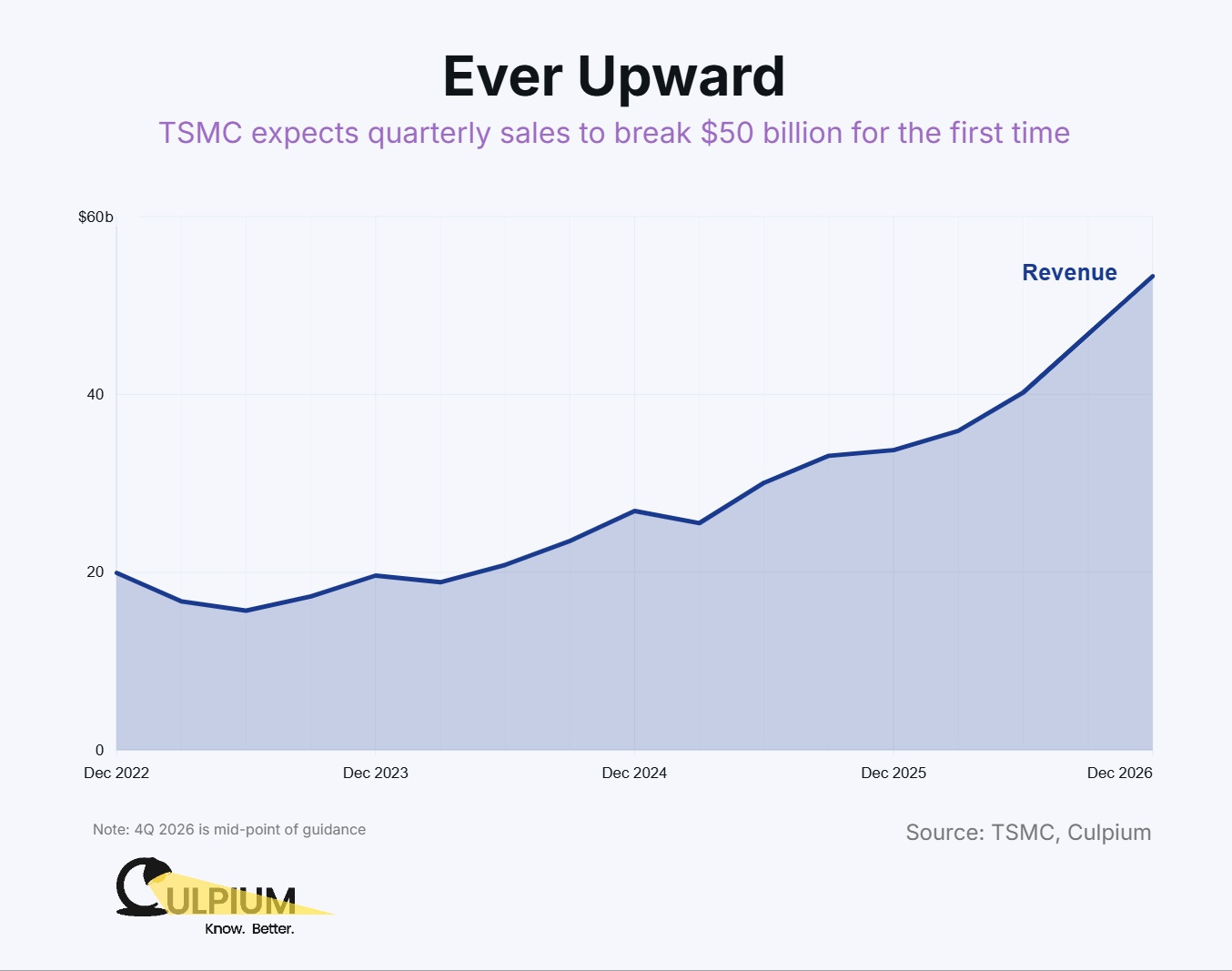
TSMC posted record revenue, earnings, shipments, and average prices. It then used its third-quarter investor conference to forecast even higher sales and earnings while raising its full-year forecast.
This AI boom has been good for Chip Kong.
High-performance computing revenue (read: AI chips) jumped 22% from the prior quarter to account for 68% of sales. That helped average price per wafer break through $10,000 to the highest on record.
But nestled among talk of the world’s growing AI appetite and record earnings were some important nuggets that help us understand how the world’s largest chipmaker sees its place in the world, and how its world may look in coming years.
The September Culpium AI Supply Chain Index (CASCI) posted its first decline in a year with capacity and midstream component supply both hit by labor & manufacturing shortages.
Midstream slowdown was foreshadowed in last month’s CASCI Tier-by-Tier report (Culpium Premium members only)
Culpium’s proprietary CASCI Composite report is sent free to all registered subscribers every month.
CASCI is a proprietary index developed by Culpium based on real data. Not sentiment or surveys. Not investment advice.
CASCI is a weighted index tracking revenue of Taiwanese companies in the AI compute supply chain. Taiwanese companies make up the majority of upstream, mid-stream, and downstream of AI server manufacturing.
Notes for Editors & Analysts:
CASCI is published monthly by Culpium as a service to readers. Media and analysts are welcome to cite CASCI or the Culpium AI Supply Chain index, with attribution and link. For example, “AI server manufacturing remains strong, according to the latest CASCI report from Culpium.” Data graphics may be reproduced with credit. Entire contents of Culpium or CASCI reports may not be reproduced unless a publishing fee is paid.
“He said his biggest concern was that nobody would supply him with chips.
“I told him: ‘Don't worry. As long as you're willing to pay, your chips will definitely be there.’”
Good Evening from Taipei,
Two years ago TSMC Chairman CC Wei made a promise to a client.
You need to be a registered (free) subscriber of Culpium to read further. Culpium offers exclusive news and unparalleled insights from veteran award-winning tech journalist Tim Culpan.
The Supply-Chained Podcast: When Thai Floods Hit HDDs Tim & Jon recall the year massive floods hit Thailand, and the lessons to be learnt for the supply-chained.
SpaceX and Terafab founder Elon Musk today confirmed my story on talks between TSMC and Terafab.
Late Friday I reported exclusively that TSMC was exploring ways to work with SpaceX’s Terafab project. “The most likely scenario is for TSMC to try to own and operate the new factory,” I wrote. “These plans are not set in stone, with other variations on the cooperation also being considered.”
“Just discussions, but something may come of it,” Musk wrote on X a few hours later.
Musk was guarded in his confirmation. He should be, and I can understand why.
He’s dealing with many competing issues when it comes to founding and scaling a hugely ambitious semiconductor project. Choosing a partner is very big decision, and he’d be wise to not rule anything out, or in, until a deal is signed.
Since publication I have had numerous further conversations with people familiar with the project.
The story of how a TSMC-Terafab collab came to be on the table is fascinating, and one which I plan to share with you soon.
To that end, make sure you’re subscribed to Culpium because I’ll be delivering the fuller rundown in coming days.
Got a tip? Want to share something with me? I am looking to learn more about TSMC, Texas, Terafab and anything else in the chip space. I will need to verify your credentials, but can protect your identity. No source has ever lost their job from talking to me — and I’ve been doing this 25 years. No PR pitches, please.
Reply to this email, or Email tculpan (A) proton (.) me (don’t send anything sensitive, I’ll move you to something secure)
But there’s another thing.
My original report, here at Culpium, started an unintentional flame war. Apparently Intel fans felt aggrieved, calling it fake news and BS.
I am writing this note to all my subscribers — free and premium — not as a victory lap, though it’s nice to have official public confirmation of something I already knew to be true.
Instead, I want to let you know how I operate and what you can expect from Culpium.
Early readers know my work, and many have followed me for 20 years since I started writing for Bloomberg (start date: 30 May 2026). I left two years ago to run Culpium independently, and those loyal supporters have joined me here. I am truly thankful.
What You’re Getting
But many people do not know me and are new to my work, and thus are quick to brand my reporting as rumor-mongering or fake news.
First, I don’t publish rumor and I don’t make up stories. There are plenty of fascinating stories about the business of tech to not need to fabricate it.
Secondly, I take a lot of time to investigate tips and ideas. I very rarely publish based on a single source.
By way of example, I was kicking myself Wednesday morning when Digitimes’ Monica Chen and Reuters’ Lee Wen-yee published news of TSMC exploring a Texas investment beyond its Arizona footprint. I’d known about these plans for around six weeks, but I didn’t have enough corroborated information to bring it to you.
So, to you, my readers I apologise for sitting on news I believed to be true — but I won’t hit publish until I am confident I have spoken to enough people and got a full picture of the situation. That sometimes means you will not get it first from me.
But when you do, be confident I’ve done the work.
Finally, yes I charge money.
Culpium was operating for two years — including a health hiatus — before I turned on the cash register. My plan is to keep delivering as much as I can for free. But sometimes I’ll need to put it behind a paywall.
Culpium is priced well below peers, and I know for a fact that there’s no one covering the technology sector from Taiwan — the home of hardware — with the same rigour and diligence.
TSMC is exploring ways to work with Elon Musk’s Terafab to help the startup chipmaker run its new semiconductor factories in Texas, my sources tell me.
Culpium is an independent media outlet with a track-record of breaking news on the Asian technology industry.
You need to a free subscriber to read beyond this point. Sign up now.
Culpium: Independent, unbiased, experienced. No agenda. No Fluff.
Note:Culpium articles may not be copied or reproduced without prior written permission and until a publication fee is paid. Media can summarize key points with a clear link to the original placed within the first screen.
Anthropic’s proposed $2 trillion IPO price is extraordinary.
Data revealed by Reuter’s Echo Wang tell me the numbers do not work. Yet.
But the AI company may be able to grow into that valuation.
Let me show you how by comparing Anthropic to a few other famous IPOs in the same space. I’ve chosen Amazon’s 1997 IPO, Google in 2004, and Facebook in 2012 because they represent a cross-section of companies in the broader internet space. The data is largely similar even when you widen the pool of peers.
First, the numbers, according to Wang’s report at Reuters published on 29 September based on the outlet’s viewing of Anthropic’s IPO Prospectus:
Don’t worry about that net loss. It’s mostly a function of funky accounting and paper shuffling. Operating income is what matters. The $2 trillion valuation probably isn’t in the filing (it rarely is), so that figure likely comes from bankers and company executives.
Photo: Adobe Stock
I haven’t seen the prospectus which Reuters viewed, so I need to make some assumptions.
Most of this piece is free, but you need to be a subscriber to keep reading.
PS: Did you know we have a podcast? Jon Y of Asianometry and myself host a weekly discussion on AI, hardware, software and the business and finance of tech. Check out the Supply-Chained pod.
More From Culpium:
*If the $7 billion is that year’s cost, rather than the cash flow line item of Purchases of PPE, then this wouldn’t be measured as capital intensity. It would likely come under cost of goods sold, or cost of sales, and impact gross profit.

 Login